
Hampton Projected Versus Actual Release
A projected release date is a current calculation based on the sentences, credits, and legal restraints known to the custodian. It can move. An actual release date records an event that already happened. Keep those labels intact. If VADOC displays a future projected date, do not rewrite it as “release date.” If a jail record shows a past exit time and release transaction, that is evidence of the event from that jail.
Pretrial detainees usually have no computed sentence-completion date. Their departure depends on bond, a court action, dismissal, transfer, or another event. Sentenced people may have a local or state calculation. Even then, reaching a date may lead to probation, parole, post-release supervision, or transfer rather than freedom from all authority.
- Projected date
- The custodian’s current estimate under the sentence and credits in its system.
- Actual release
- The recorded event when custody ended or changed.
- Detainer
- A request or order from another authority to hold or transfer the person.
- Discharge
- The formal end of the stated custody or supervision obligation.
Find Hampton Projected Release Dates
Start with every active sentencing order. Read total imposed time, suspended time, whether terms run at the same time or one after another, and credit for pretrial confinement. Next, identify who computes the term. Hampton Sheriff Inmate Records handles local time. VADOC handles many state-responsible sentences. WTRJ must be consulted when it physically holds the person and its record is part of the custody path.
- Determine whether the person is pretrial or sentenced. Search both Hampton General District and Circuit Court when a felony path may span both courts.
- Read the signed order, not just a docket summary. Note imposed and suspended time, concurrent or consecutive terms, and credited confinement.
- For local custody, contact Hampton Sheriff Inmate Records. Ask for the projected local date and the existing time-computation record.
- For state custody, search the VADOC Inmate and Supervisee Locator by seven-digit DOC number when known.
- Copy the field label exactly. If more detail is needed, ask VADOC for the release, discharge, and time-computation documents.
- On the expected date, verify with the current custodian and check for another agency’s hold or transfer.
The full Hampton release record and cross-custodian search path are available on the Hampton released-inmate home page. Use that path after the date passes to establish what actually happened.
Hampton VADOC Release Date Lookup
VADOC’s locator is the principal public source when a Hampton defendant became state-responsible. A name search requires at least the first three letters of the first name and the full last name. A seven-digit VADOC number is more precise. Location, race, gender, and age-range filters can narrow results. VADOC says the service updates daily, while also warning that displayed information can be inaccurate or outdated.
On a match, save the name, VADOC number, current location or status, release-related field, and capture date. A future date is projected. A past release or discharge field documents VADOC’s record of an event. Someone released from prison to community supervision can remain visible as a supervisee. Someone fully discharged may later vanish, which is why a historical record request matters.
The official VADOC locator is shown in the source capture below.
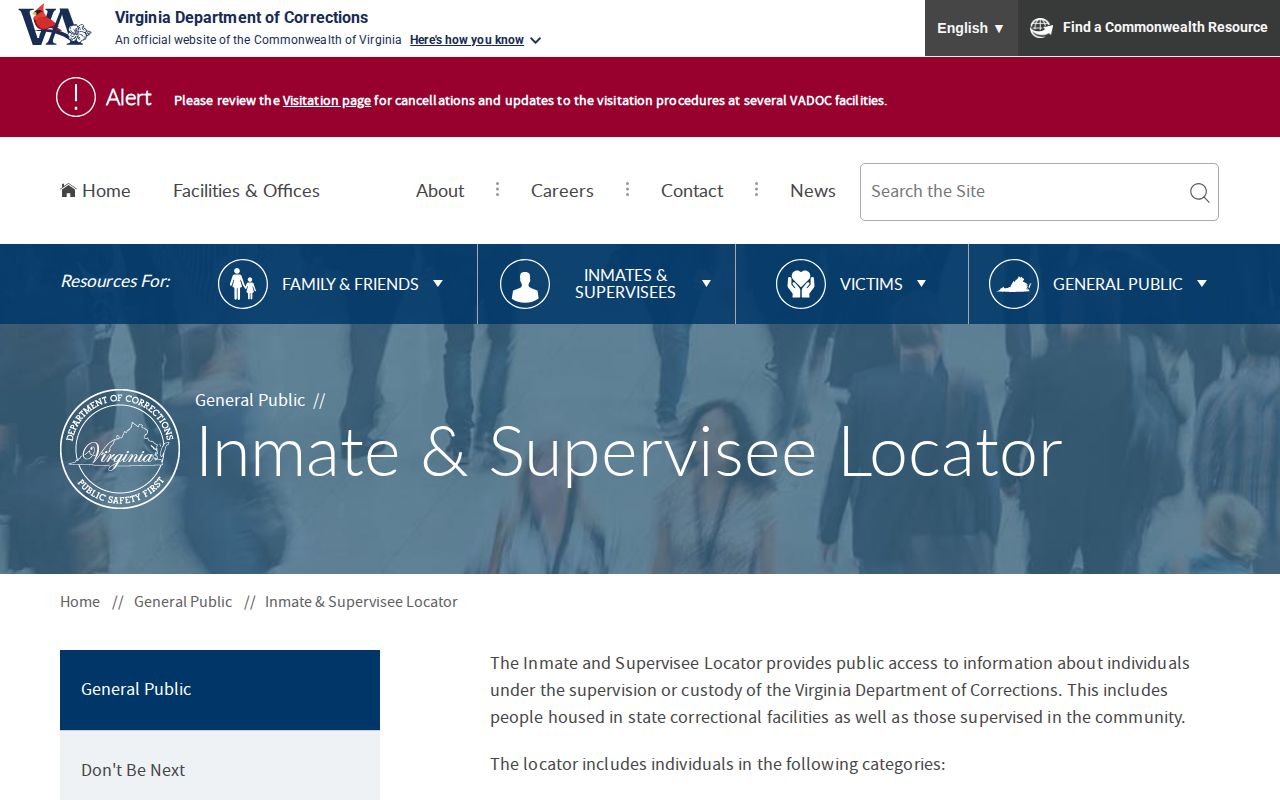
The capture identifies the state search channel. It does not replace Hampton’s local calculation for a city or regional jail sentence.
If the locator lacks a projected date, do not derive one from the sentence shown elsewhere. Ask VADOC whether the public field is suppressed, unavailable, or still under calculation. For a past event, request the release or discharge date, release type, facility of release, sentence-credit computation to the extent releasable, and supervision district or final status. The court judgment supplies the legal sentence. VADOC supplies its administration of state time.
Hampton Local Release Date Calculation
Hampton has a distinctive local computation channel. The Sheriff’s Inmate Records unit says staff compute local time, submit state time to VADOC, calculate good time for program participation, process court documents, answer correspondence, and prepare daily, weekly, and monthly reports. A generic online calculator cannot reproduce that work.
For a local term, give the unit the person’s name, booking number if known, custody dates, facility, and court case number. Ask for the current projected date, the existing calculation sheet or releasable time-computation record, the jail-credit entries, and any court document that changed the term. If WTRJ holds the person, ask WTRJ for its event record as well and identify which authority controls the calculation.
The official Hampton Inmate Records description appears in the source capture below.
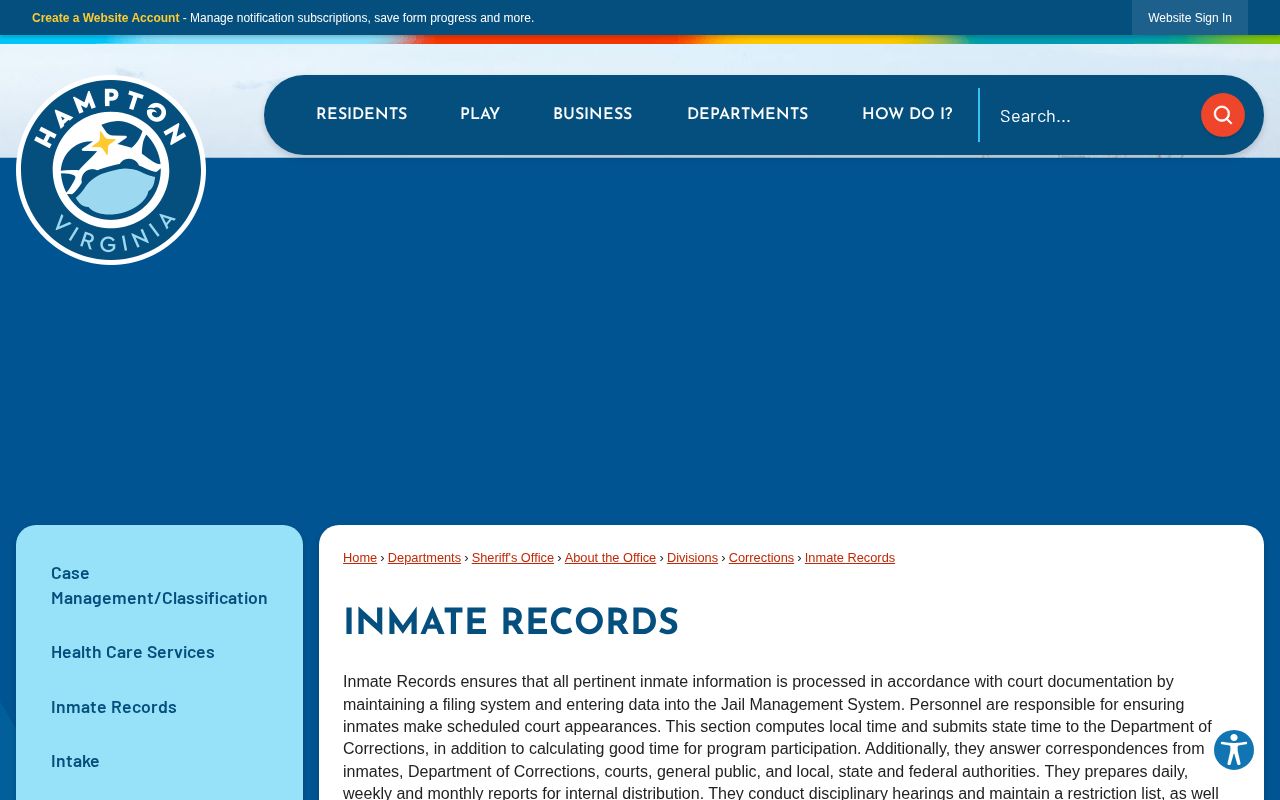
The source confirms that local release dates are a records-unit calculation, not an estimate made by subtracting a flat percentage.
Hampton Release Credits and Statutes
Virginia’s credit systems depend on offense date, sentence type, eligibility, and current law. The common “85 percent” shorthand is not a universal rule. For many covered post-1995 felony sentences, the ordinary earned-sentence-credit cap of 4.5 days for each 30 days served means that 30 served days plus 4.5 credited days satisfy 34.5 sentence days. The served share is about 86.96 percent, not precisely 85 percent.
Eligible ESC-2 time can differ. At a maximum 15 credits per 30 days served, 30 served plus 15 credited days satisfy 45 sentence days, roughly two-thirds served. Serious listed offenses remain restricted, and effective-date rules matter. The live Va. Code Chapter 6 credit provisions, including § 53.1-202.3, must be checked for the person’s sentence.
Older good-conduct allowance uses separate classes under § 53.1-201. Class I may earn 30 days per 30 served, Class II 20, Class III 10, and Class IV none. Sections 53.1-199 through 53.1-202 govern that older system, while § 53.1-116 connects certified local jail time to state calculation. Mixing old good-conduct classes with post-1994 earned sentence credits creates a false date.
Note: Lost credits, a lower classification, or ineligible time increase the share that must actually be served.
Why Hampton Release Dates Change
A calculated date is only as current as its inputs. Court changes, credit changes, and another agency’s legal authority can all move it. Ask which record caused the revision instead of assuming the first date was an error.
| Change | Effect on the projected date | Source to check |
|---|---|---|
| Court amendment or appeal | Can change imposed time, suspended time, or sentence structure | Signed Hampton court order |
| Concurrent or consecutive correction | Changes whether terms overlap or follow each other | Court and custodian calculation |
| Jail credit correction | Adds or removes credited pretrial confinement | Inmate Records, VADOC, and certified jail record |
| Earned credit status | Credit can be earned, lost, restored, reduced, or excluded | Current custodian’s time computation |
| Detainer or warrant | May block community release or cause a transfer | Holding agency and court record |
| Parole or conditional action | May create a new planned path subject to conditions and holds | Parole Board result and VADOC |
| Revocation | Can activate suspended time or alter the remaining term | Signed revocation order |
VADOC release procedures require review for warrants, detainers, continued-custody orders, disciplinary or classification matters, and uncalculated sentences. Those checks explain why a projected date may not become an actual exit. A date may also mark mandatory release into supervision rather than unconditional discharge.
Changes can run in either direction. Restored credit or a corrected confinement start may move the date earlier. Lost credit, a new consecutive term, or a hold can move it later or change the destination. The safest comparison uses two dated calculations and the record that changed between them. A verbal estimate without its source date is too weak to resolve a conflict.
Hampton Parole Date Is Different
Virginia largely ended discretionary parole for felony offenses committed on or after January 1, 1995, subject to exceptions. Older and otherwise eligible sentences require a separate parole analysis under § 53.1-151. The Virginia Parole Board decides eligible cases. Its decision is not the same as VADOC’s computed projected date or the facility’s actual release transaction.
A Board grant may remain subject to an effective date, release planning, conditions, and detainers. A denial leaves the existing sentence calculation in place. Deferral means a final decision has not yet been made, while rescission can withdraw an earlier grant. Compare the Board result with VADOC status and the Hampton sentencing record.
VADOC’s facility release information says a person satisfying the sentence may be discharged or released on parole and receive release documentation. The packet can include an Order of Release and Conditions of Probation or Parole. These signed records are stronger than a remembered estimate.
Confirm Hampton Actual Release Dates
Check again on the expected release day. For Hampton local custody, ask Sheriff Inmate Records for the release date and time, transaction type, releasing authority, and destination agency if transferred. For WTRJ, ask whether the person left for the community, returned to Hampton, entered VADOC, or moved under federal authority. For VADOC, preserve the locator result and request the signed release or discharge record when precision matters.
Notifications can supplement that check. The Hampton VINE inmate check explains local jail alerts and the separate NAAVI route for eligible VADOC victim notifications. An alert can lag or report a transfer. Always confirm with the agency named in it.
VADOC Correspondence Unit / Court & Legal SectionP.O. Box 26963
6900 Atmore Drive
Richmond, VA 23261
804-674-3000
docmail@vadoc.virginia.gov
Ask about the current time-computation record and release documents.
If a fully discharged person no longer appears in the locator, use VADOC’s inactive-record procedure. Identify the DOC number and ask for actual release or discharge date, legal authority, sentence-credit computation, release facility, destination or transfer information, and final supervision discharge. Absence alone proves none of those facts.